

TA.TEC Consulting
Where Wire Bond Contamination Really Matters
Wire, bond pad, or EMC? How chlorine and sulfur contamination affect the reliability of Au-Al and Cu-Al wire bonds differently.
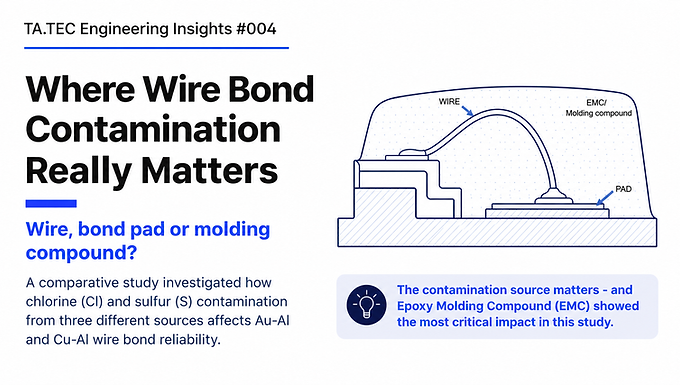
Chlorine (Cl) and sulfur (S) contamination from three sources – wire, bond pad, and epoxy molding compound (EMC) – were investigated for Au-Al and Cu-Al bonds. Reliability was evaluated using HTS and bHAST.
Under the investigated conditions, EMC showed the most critical impact. For Au-Al, failure was observed only with 500 ppm Cl from EMC. More failures occurred for Cu-Al, with the majority associated with contamination from EMC and the bond pad. Cl and S also showed different degradation mechanisms.
The reliability response did not depend on the contaminant alone, but on the combination of contamination source, contaminant species, wire-pad combination, and reliability test.
Among the investigated sources, EMC showed the most critical impact. Under bHAST, Cu-Al was more readily attacked by Cl than Au-Al. Cl and S also showed different degradation behavior at the ball-pad interface.
The results apply to the investigated Au-Al and Cu-Al systems, chlorine and sulfur, the contamination sources wire, bond pad, and EMC, and the described HTS and bHAST conditions.
They do not establish a general rule for other wire materials, contaminants, concentrations, package materials, or reliability tests. The sulfur-related mechanisms described in the study are partly based on the authors’ interpretation.
Research Source
Liao Jinzhi Lois, Wang Bisheng, Zheng Haipeng, Zhang Xi, Li Xiaomin, Hua Younan, Fu Chao, Tee Weikok, Yee Boonhwa, Mao Songlin
Comprehensive study of wire bond reliability impacts from wire, molding compound and bond pad contaminations
2019 IEEE 21st Electronics Packaging Technology Conference (EPTC), IEEE, 2019
Engineering Insight PDF herunterladen (Englisch)